
Fate Number Calculator: What It Means and How It’s Different from a Destiny Matrix
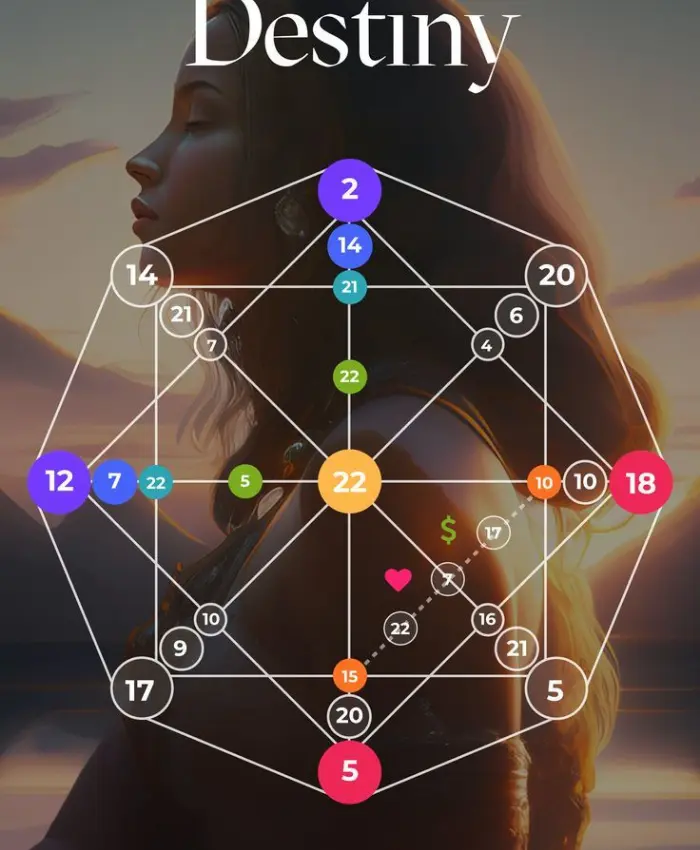
Quick answer: Fate number is a casual name for what’s more formally called your Destiny Number (or Expression Number) in traditional numerology calculated from the letters in your full birth name, not your birth date. This is a completely different reading from a Destiny Matrix chart, which uses your date of birth to map 22 positions across a full chart. Generate your free Destiny Matrix chart here to see the birth-date-based version.
If you searched “fate number calculator,” there’s a good chance you landed here expecting one specific thing. You’re about to find out there are actually two very different systems using similar-sounding names. That’s a genuinely common mix-up, and it’s worth sorting out properly before you calculate anything.
Is a Fate Number the Same Thing Everywhere?
Mostly, yes. Across the numerology sites that use this term, it’s almost always an informal stand-in for something more precise. That’s the Destiny Number or Expression Number, a core reading in traditional Western numerology. A smaller number of sources use it more loosely, sometimes blurring it with the life path number instead, which is a separate calculation entirely.
For clarity, the rest of this guide uses Destiny Number and Expression Number interchangeably, since that’s the term used by the most established sources in this tradition.
What Is This Number, Exactly?
It’s one of the core readings in Pythagorean numerology, derived entirely from the letters in your full birth name. It has nothing to do with your date of birth. It’s meant to describe your natural talents and the goals you’re working toward. It also points to the traits that show up once people get past a first impression of you.
This is different from your life path number which comes from your birth date and describes the broader journey and lessons you’re likely to encounter. The two are often read together, but they’re calculated in completely different ways, using entirely different source information.
The Pythagorean letter to number system this calculation relies on traces back to the philosopher Pythagoras. He theorized that letters, like numbers, carry vibrational qualities. Modern numerologists have built on that foundation considerably since, but the core letter assignment method has stayed fairly consistent across most Western sources.
How Is It Calculated?
Each letter of your full birth name gets assigned a number, one through nine, based on its position in a standard Pythagorean chart:
| Number | Letters |
|---|---|
| 1 | A, J, S |
| 2 | B, K, T |
| 3 | C, L, U |
| 4 | D, M, V |
| 5 | E, N, W |
| 6 | F, O, X |
| 7 | G, P, Y |
| 8 | H, Q, Z |
| 9 | I, R |
You add up the numbers for your first, middle, and last name separately. Reduce each to a single digit, unless it’s a Master Number (more on that below). Then add those totals together and reduce once more.
A Worked Example
Take the name Jordan Alex Reed as an example.
First name — Jordan: J(1) + O(6) + R(9) + D(4) + A(1) + N(5) = 26 → 2+6 = 8
Middle name — Alex: A(1) + L(3) + E(5) + X(6) = 15 → 1+5 = 6
Last name — Reed: R(9) + E(5) + E(5) + D(4) = 23 → 2+3 = 5
Adding the three results: 8 + 6 + 5 = 19 → 1+9 = 1
This name lands on 1. Different names, of course, produce different results try the calculation with your own full birth name using the letter chart above.
What Are Master Numbers?
If any stage of the calculation lands on 11, 22, or 33, that number is kept as is rather than reduced further. These are known as Master Numbers. They’re considered to carry a stronger, more demanding version of the energy of their reduced form (11 relates to 2, 22 to 4, and 33 to 6). Traditional numerologists generally treat these as carrying more intensity both greater potential and a heavier weight to work with than the single digit numbers they’re built from.
How Different Sources Calculate This Slightly Differently
Worth knowing before you compare results across different calculators: most Western sources use the Pythagorean system described above. A smaller number uses the Chaldean system instead, which assigns different numeric values to letters and caps values at 8 rather than 9. If you calculate your number on two different sites and get two different answers, this is almost always why not a mistake on either site’s part, just a different underlying tradition.
What Your Number Might Mean
A brief overview of each Destiny Number, in the tradition most sources agree on:
| Number | Core Theme |
|---|---|
| 1 | Leadership, independence, initiative |
| 2 | Cooperation, diplomacy, sensitivity |
| 3 | Expression, creativity, sociability |
| 4 | Structure, discipline, reliability |
| 5 | Freedom, adaptability, curiosity |
| 6 | Nurturing, responsibility, harmony |
| 7 | Introspection, analysis, depth |
| 8 | Ambition, authority, material success |
| 9 | Compassion, idealism, closure |
| 11 | Intuition, inspiration, heightened sensitivity |
| 22 | Large-scale building, practical vision |
| 33 | Selfless service, nurturing on a larger scale |
This Reading vs. Life Path Number
These two get confused constantly, so it’s worth stating plainly: your Life Path Number comes from your birth date and describes your overall journey and the lessons you’re likely to face. This name-based reading, by contrast, describes your natural talents and the direction you’re meant to grow into. Neither one replaces the other most traditional readings look at both together.
What Is a Destiny Matrix?
This is where the naming overlap gets genuinely confusing. A Destiny Matrix chart uses the word destiny too, but it’s a different system altogether. Rather than your name, it uses only your date of birth. That gets mapped across a geometric chart of 22 positions, each tied to one of the Major Arcana.
Where the reading above gives you one number to interpret, this alternative gives you a full chart. That includes your Core Essence, your Karmic Tail, your Love Line, your Money Line, and several other positions, all calculated from the same birth date. The method is commonly associated with numerologist Natalia Ladini, generally traced to the early-to-mid 2000s much newer than the Pythagorean tradition behind the name-based reading above.
Using the same sample date from our how to read your chart guide, their Core Essence number is 12, corresponding to The Hanged Man. That chart belongs to someone born 12 April 1988. That single number is just one of many positions in a full chart, not a standalone reading the way the name based calculation is.
Which One Are You Actually Looking For?
| Name-Based Reading | Destiny Matrix | |
|---|---|---|
| Calculated from | Your full birth name | Your date of birth only |
| Output | One single number (or Master Number) | A full chart across 22 positions |
| Tradition | Pythagorean numerology, centuries-old lineage | Modern method, traced to the early-to-mid 2000s |
| Best for | A quick read on talents and natural direction | A detailed map of patterns across relationships, money, karma, and purpose |
If you’re after a quick, single number read based on your name, the calculation earlier in this guide covers it. If you’re looking for a fuller picture based on your birth date alone no name needed generate your free chart here instead.
A Quick Way to Decide Which You Want
If you’re not sure which reading matches what you were searching for, ask yourself one question. Are you more curious about a single trait tied to your name or a fuller picture of patterns across your relationships, finances, and life direction? The first points to the calculation above. The second points to a full chart, which only needs your birth date to generate.
Why These Terms Get Confused
Part of it is simple word overlap. Fate and destiny are near synonyms in everyday English, so it’s natural to assume any calculator using either word is doing the same thing. Part of it is that numerology as a field has never had one central authority standardizing terminology. Different traditions and different sites have landed on overlapping names for genuinely different calculations. Neither system is more correct than the other. They’re just answering different questions using different inputs.
Using Either Reading Alongside Real Self-Reflection
Whichever calculation you end up using, the number itself is only a starting point. A single digit result, however it’s derived, works best as a prompt for reflection rather than a fixed label. If your result points to leadership qualities for instance the useful question isn’t does this describe me? But where in my life am I already showing this, and where am I holding back from it? Numbers are more useful as mirrors than as verdicts in either tradition.
This matters more once you compare the two systems side by side. A single name-based number gives you one lens. A full birth-date chart gives you several lenses at once, each interacting with the others which is why some people find a fuller chart more useful once they’ve outgrown what a single number can tell them.
Common Mistakes
Entering a birth date into a name-based calculator, or vice versa.
The two systems need completely different information, and mixing them up gives a meaningless result.
Assuming fate number always means the same calculation.
As covered above it’s used inconsistently across different sites always check whether a given calculator asks for your name or your birth date before trusting the result.
Confusing Master Numbers with Karmic Debt Numbers.
Master Numbers (11, 22, 33) come from your Destiny/Expression Number calculation. Karmic Debt Numbers (13, 14, 16, 19) are a separate concept entirely, and neither is the same as anything in a Destiny Matrix reading.
Expecting a Destiny Matrix chart to use your name at all.
It doesn’t. If a site asks for your full name for a Destiny Matrix reading it may be blending traditions or using the name for personalization rather than the actual calculation.
FAQs
Related guides:
How to Read Your Destiny Matrix Chart
Destiny Matrix Karmic Tail, Explained
Destiny Matrix Love Line, Explained
Destiny Matrix Money Line, Explained
The 22 Arcana Meanings in Full
Destiny Matrix Compatibility