
Destiny Matrix Karmic Tail: What It Means and How to Find Yours
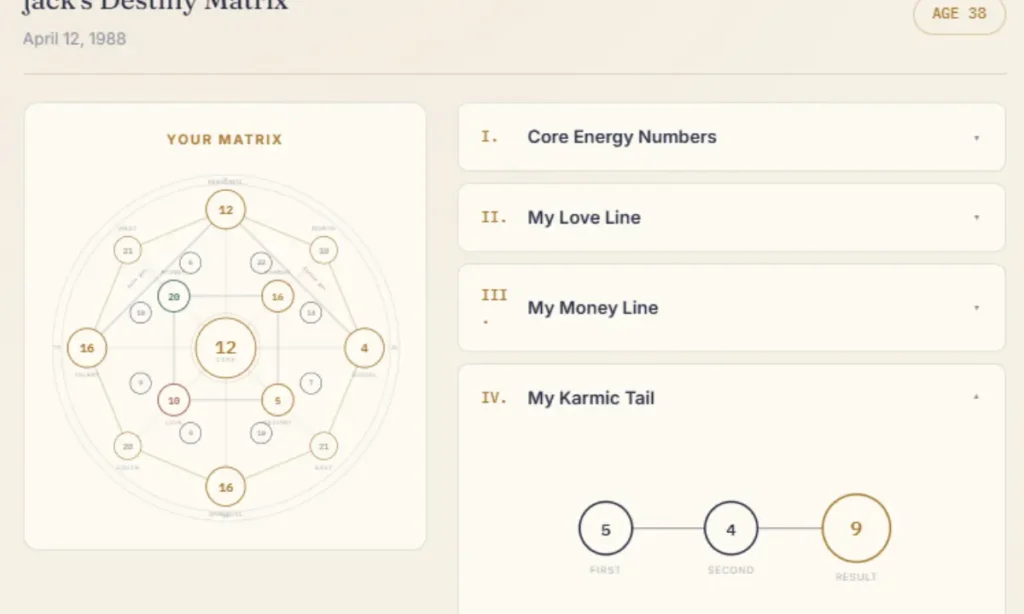
Your Karmic Tail is a three number sequence in your Destiny Matrix chart that points to a repeating pattern carried from earlier in your life, or from past experiences you haven’t fully worked through. It’s calculated from your birth date, sits below your main chart, and each of the three numbers builds on the one before it. Generate your chart here to see your own sequence.
You’ve probably noticed something: certain problems keep showing up in your life, wearing different outfits. Different job, same burnout. Different partner, same argument. Different city, same restlessness.
The Karmic Tail is the part of the Destiny Matrix built specifically to name that pattern.
This guide covers what it is and how it’s calculated. It explains what the three positions mean and how to read your own sequence, including a real worked example you can follow with your own numbers. We’ll also look at where this three number reading shows up in relationships. And we’ll clear up a common mix up with an older, unrelated numerology term.
What Is a Karmic Tail in the Destiny Matrix?
It’s a three number chain that sits at the base of your Destiny Matrix chart. Your Core Essence or Love Line are single numbers. This one is different read as a sequence, one number leading into the next, then resolving into a third.
The tradition behind this idea borrows from numerology and the symbolism of the Major Arcana. Each of the three numbers corresponds to one of the 22 Arcana. Together they tell a short story where a pattern started, what keeps it going, and where it’s pointing if left unaddressed.
This isn’t the same as your Karmic Number, which is a single value showing up elsewhere in your chart. The tail is longer and more specific. Most people find it a lot more useful, too, because a sequence explains a process, not just a state.
The concept sits within the broader Destiny Matrix framework. The modern method is commonly associated with numerologist Natalia Ladini and is generally traced to the early to mid 2000s, though the exact origin isn’t well documented in independent sources. Different practitioners have built on the original method since. That’s part of why you’ll see small variations in how different calculators present it. The underlying goal stays the same across versions: turn a repeating struggle into something specific enough to actually work with.
How Is the Karmic Tail Calculated?
It comes from the same base numbers as the rest of your chart: your day, month, and year of birth. Each gets reduced down through simple addition until it lands between 1 and 22.
Here’s the general logic:
You don’t need to do this by hand. Our free calculator handles the reduction automatically and shows your three-number sequence the moment you enter your birth date.
One honest note: different Destiny Matrix tools calculate the tail slightly differently, depending on which version of the method they follow. Your exact three numbers may not match a friend’s calculator result if you used a different site, even with the same birth date. What stays consistent is the interpretive approach below reading position by position, not the sequence alone.
What the Chart Actually Looks Like
If you’ve generated your reading, you’ll see the sequence displayed as three connected circles, usually below or beside the main octagram. The first circle feeds into the second. The second feeds into the third a small, self contained flow that visually separates it from the rest of your chart.
This layout is intentional. Every other part of your Destiny Matrix chart is either a single point or a pair. This one is drawn as a chain for a reason it’s meant to be read as a sequence, not scanned as three isolated data points. If you’re looking at your chart, you might wonder which three circles make up this reading. Look for the set that’s visually connected in a line. It won’t sit at a corner of the main shape.
The Three Positions, Explained
Each number in the sequence carries its own role. Think of it less like three separate facts and more like a short story told in three acts.
| Position | What It Represents |
|---|---|
| First number | Where the pattern began often something inherited, absorbed early, or set in motion by circumstances outside your control |
| Second number | What keeps the pattern active the behavior, belief, or reaction that feeds it in the present |
| Third number | Where the pattern is heading the resolution, lesson, or shift it’s pushing you toward |
Reading it means going through these three in order, not picking your favorite one. The first number without the third just tells you where you came from. The third without the first tells you where you’re headed, but not why. Skipping the middle number is the most common shortcut people take. It’s usually the one that matters most, since that’s the number describing what’s actually keeping the pattern alive today.
A Worked Example: Reading the Sequence
Theory is easier to apply once you’ve seen it done. Let’s use the same sample chart from our guide on how to read your Destiny Matrix chart: a person born 12 April 1988.
Their three-number sequence is 5 – 4 – 9. Here’s how each part reads on its own, then together.
5 (The Hierophant): the starting point. This suggests the pattern began with inherited beliefs or rules something absorbed from family, culture, or early authority figures, not necessarily questioned at the time.
4 (The Emperor): what keeps it active. A recurring struggle with control, structure, or authority either resisting it or unconsciously recreating it in their own life.
9 (The Hermit): where it’s resolving. The pattern is pushing this person toward solitude and self trust learning to set their own rules instead of inheriting or fighting someone else’s.
Read together: inherited structure, a struggle with control, resolving through self-trust. That’s a coherent story, not three random numbers.
Generate your own chart to see your sequence and read it the same way.
Signs It’s Actively Playing Out
This pattern doesn’t sit quietly in the background. Most people notice a few signs when it’s active:
None of these prove anything on their own. Everyone has bad days and awkward patches. But if two or three sound familiar over a longer stretch of time, not just one rough week, that’s a signal worth noticing. Look closer at your own sequence rather than treating each incident as unrelated.
How It Shows Up in Relationships
This isn’t only a personal reading it shows up between two people too. When two people’s sequences share a number, or when one person’s third number matches the other’s first, something shifts. The relationship often carries a stronger sense of “we’ve done this before,” for better or worse.
This doesn’t mean the relationship is doomed or destined. It means the two of you may be working through connected material. That can make the relationship feel unusually intense in both directions. It can be deeply healing or repeatedly frustrating, depending on how consciously it’s handled.
If you want to see how your sequence interacts with someone else’s, use our compatibility calculator and read both charts side by side. Our full Destiny Matrix compatibility guide walks through how to interpret the combined reading. Repeating numbers between two people tend to intensify whatever theme they touch.
The Past-Life Question
Some readers approach this through a past-life lens. The idea: the pattern isn’t just from this lifetime, but carried over from an earlier one. Others prefer to read it purely as inherited or early life conditioning, without the past-life framing at all. Neither reading is more “correct” within the tradition. It largely comes down to which framework helps you actually use the information.
Both approaches lead to the same practical question what am I still carrying that I didn’t consciously choose? You don’t need to settle the past-life question to get value from the tail. The pattern recognition part works either way.
Karmic Tail vs. Karmic Debt Numbers: Don’t Confuse the Two
If you’ve researched numerology before, you may have come across Karmic Debt Numbers 13, 14, 16, and 19 from traditional Pythagorean numerology. That’s a different system entirely.
Karmic debt numbers come from the letters in your name or specific birth date totals in classic numerology. A Karmic Tail is a Destiny Matrix concept, built from a three number sequence unique to this method. They’re not interchangeable, even though both use the word karmic.
The 26 Named Combinations
Across the Destiny Matrix tradition, practitioners commonly reference 26 named combinations. Each pairs a specific three number sequence with a short descriptive name and theme. Naming can vary slightly between sources, but the sequences below reflect the most consistently referenced set across independent calculators and guides.
15-8-11 — Physical Aggression. A pattern around suppressed anger or a tendency to meet conflict with force rather than words.
6-5-17 — Pride. A cycle built around needing to be right, often at the cost of connection.
18-6-6 — Love Magic. An intense pull toward relationships that feel fated, sometimes at the expense of clear judgment.
9-3-21 — The Overseer. A pattern of taking on responsibility for others’ outcomes, often more than was asked.
18-9-9 — The Wizard. A tendency to withdraw and self-isolate when overwhelmed, mistaking distance for control.
12-19-7 — The Warrior. Repeated battles, literal or emotional, that test resilience and force growth through conflict.
9-15-6 — World of Passions. A pull toward intensity and drama in relationships, sometimes confusing chaos with depth.
18-3-12 — Physical Suffering. A pattern connected to the body carrying unresolved stress, often showing up as chronic tension.
3-22-19 — Unborn Child. A theme of unfulfilled potential — plans or parts of the self that never got the chance to develop.
12-16-4 — Emperor. A recurring struggle between authority and control, either seeking it or resisting it.
21-10-16 — Spiritual Priest. A pattern around guiding others while neglecting one’s own needs.
6-8-20 — Disillusionment of Lineage. A theme of disappointment tied to family expectations or inherited beliefs that didn’t hold up.
3-7-22 — Imprisoned Soul. A pattern of feeling trapped by circumstances, real or self-imposed.
21-7-13 — Destruction. A cycle of things falling apart before they can be rebuilt on more honest ground.
18-6-15 — Dark Magician. A pattern involving the misuse of influence or persuasion, sometimes on others, sometimes on oneself.
6-20-14 — Soul Sacrificed. A tendency to give up personal needs for the sake of others, often repeatedly.
21-10-7 — Warrior of Faith. Persisting through hardship because of belief in something larger than the immediate struggle.
6-14-8 — Dictator. A pattern connected to control, either being controlled or unconsciously controlling others.
9-12-3 — Lonely Woman (or Solitary Path). A theme of isolation, sometimes chosen, sometimes circumstantial.
21-4-10 — Oppressed Soul. A pattern of feeling silenced or overlooked, often traced back to early experiences.
15-5-8 — Family Passions. Intense, sometimes volatile family dynamics that repeat across generations.
6-17-11 — Wasted Talent. A gift that was dismissed, discouraged, or never fully claimed.
9-9-18 — Magical Sacrifice. A pattern of giving something meaningful up in pursuit of transformation.
15-20-5 — The Rebel. A recurring pull to challenge authority or convention, sometimes constructively, sometimes just for the sake of resistance
We’ve intentionally left out one traditionally referenced combination from this list. Its classic interpretation touches on themes of despair that are better discussed with a mental health professional than through a numerology chart. If you’re going through a difficult time, please reach out to a counselor, doctor, or a crisis line in your area. Support is available, and you don’t have to carry it alone.
How to Work With Yours
Knowing your sequence is only step one. A few ways people actually use it:
Name the pattern out loud. Write down what the first number suggests about where it started. Naming it reduces its grip.
Watch for the second number’s behavior this week. If your middle number points to control, notice one moment you tried to control something you didn’t need to.
Ask what the third number is asking of you. Not as a prediction — as a direction. What would it look like to move one step toward that resolution?
Revisit it after a hard period. These sequences tend to feel loudest during stress. That’s usually a good time to reread yours, not avoid it.
Pair it with your Purpose reading. A pattern that keeps blocking your Personal Purpose often traces back to the same theme sitting in your first or second number.
Common Mistakes to Avoid
Reading only the first number
The starting point without the resolution just leaves you stuck in the origin story.
Treating it as a life sentence
This describes a pattern, not a verdict. Patterns can shift once they’re seen clearly.
Trying to force a dramatic meaning onto every number
Not every combination points to something intense. Some are quieter, more about a habit than a wound. Resist the urge to over-dramatize a reading that’s actually fairly mild.
Confusing it with Karmic Debt Numbers
As covered above different system, different calculation.
Ignoring the compatibility angle
Many people only read their own tail and miss how useful it is in understanding recurring relationship dynamics.
Expecting the exact same numbers on every calculator
As mentioned earlier, different tools compute this slightly differently. Don’t assume one of them is “wrong” just because the sequence looks different from another site.
FAQs
Related guides:
How to Read Your Destiny Matrix Chart
Destiny Matrix Love Line, Explained
Destiny Matrix Money Line, Explained
Destiny Matrix Compatibility: Reading Two Charts Together
Personal, Social, and General Purpose in Your Chart
Destiny Number vs. Destiny Matrix: What’s the Difference?
The 22 Arcana Meanings in Full
Destiny Matrix vs. Human Design: Which One Should You Use?